
What Is “Emergent” Regenerative Leadership? Co-Creating a Future Through Diverse People and Perspectives 【Regenerative City Inspiration Talk Vol.2 — Part 1】
On June 25, the second session of the series “Regenerative City Inspiration Talk — Exploring the Future of Regenerative Cities from Tokyo” was held at Tokyo Living Lab in Yaesu, Tokyo. This ongoing event series is organized by the Future Food Institute (FFI) in partnership with Tokyo Tatemono Co., Ltd. and the Tokyo Food Institute (TFI), as part of the broader initiative to advance the Regenerative City Tokyo vision from the YNK area—Yaesu, Nihonbashi, and Kyobashi.
The second session of this multidisciplinary series—which discusses Regenerative Cities from the perspectives of business, architecture, food, leadership, circular economy, and more—focused on the theme “Envisioning the Future of Cities Through Regenerative Leadership.”
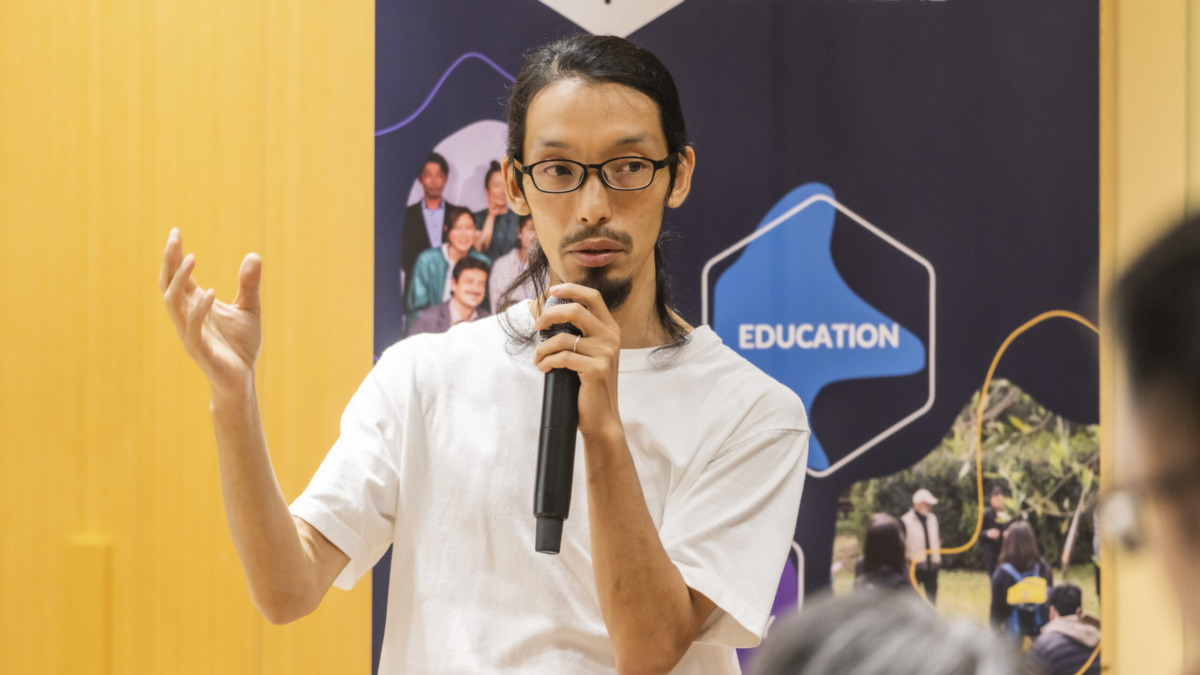
The guest speaker was Yasuhiro Kobayashi, translator of the widely discussed book “Regenerative Leadership: The DNA of Life-Affirming People and Organizations” (Eiji Press) and Representative Director of Regenerative Leadership Japan. Kobayashi shared insights into the emerging concept of regenerative leadership and the regenerative urban future that this concept envisions.
“Some of you may have heard the terms ‘regeneration’ or ‘regenerative,’” Kobayashi began, “but the era we live in now demands a fundamental shift in how we conduct business and engage in social activities.”
At the beginning of his talk, Kobayashi posed this question to the audience.
While sustainability, in its narrow sense, focuses on “reducing environmental impact,” regeneration refers to “actively engaging in the renewal of the planet and its ecosystems.”
Kobayashi explained that “the regenerative approach is fundamentally different from sustainability, which starts with problem-solving. Regeneration begins by recognizing the inherent capacity of life and the earth to renew themselves.” Instead of asking how to lessen harm, it asks, “How can we cultivate greater abundance, and where are the leverage points for doing so?” It looks at forests, oceans, and natural ecosystems, as well as local cultures, communities, and human health—considering how vitality can be restored and renewed across all interconnected systems.
For example, at the regenerative community farm Kobayashi operates in Kasukabe City, Saitama, efforts to enhance biodiversity and restore the power of natural ecosystems not only allow crops to grow without imposing environmental burdens, but also help visitors feel revitalized simply by spending time there.
“Designing our activities within the larger web of relationships and cycles—including not only humans but also nature and the environment—is the foundation of a regenerative approach.”
How, then, can regeneration be practiced within society and organizations? One answer lies in regenerative leadership.
In the book Regenerative Leadership, for which Kobayashi served as translator, this form of leadership is defined as “an approach that views organizations and businesses as interconnected living systems, nurturing the flourishing of life within the surrounding ecosystem.”
Kobayashi emphasized that “what is important here is shifting away from a ‘management and control’ style—where someone issues instructions and others execute them—and moving toward an ‘emergent’ style of leadership that grows through the involvement of diverse people and even nonhuman stakeholders.
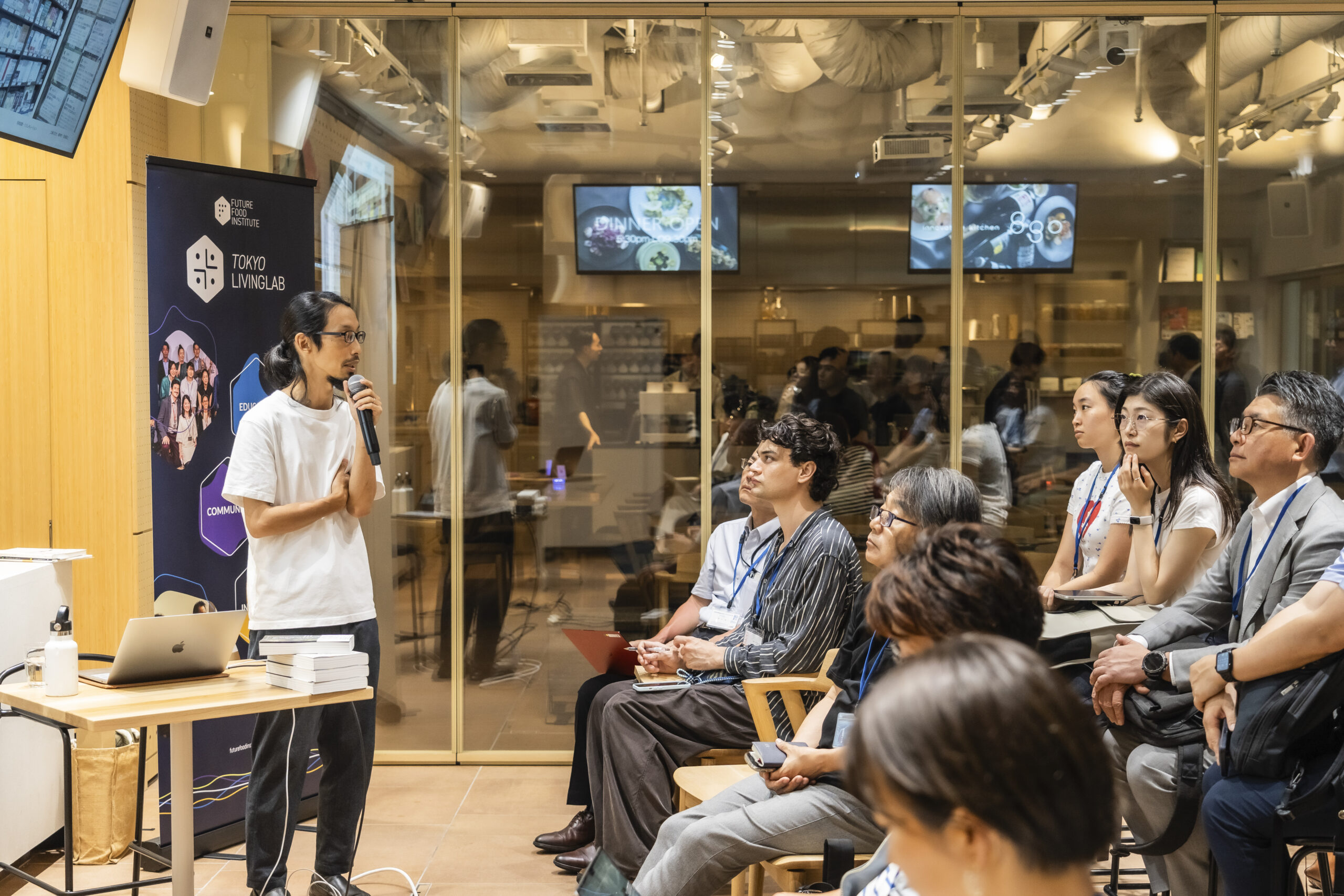
“Just as plants grow through their own inherent vitality, regenerative leadership trusts the innate strengths that each individual carries, and creates the conditions and environments that allow those strengths to unfold. In other words, it is a form of leadership that ‘nurtures life.’”
At the foundation of this leadership model is a shift from the “mechanistic paradigm” that modern society has reinforced, toward a “living systems paradigm” in which all things are interconnected. While society has advanced by breaking the world into parts and understanding it through reductionist methods—a process that has brought many benefits—it has also led to a tendency to view both people and nature merely as “functions” or “resources,” creating frameworks of fragmentation, domination, and extraction.
“In regenerative leadership, we must reframe organizations, society, and even the planet as living systems. In organizations, this means moving beyond a rigid, mechanical view defined by jobs or departmental functions, and instead recognizing them as gatherings of living beings. Within constantly shifting flows, relationships, and countless interconnections, the essential question becomes: how can we create the conditions for potential to be fully expressed? This shift in perspective is what regenerative leadership calls for.”
To put regenerative leadership into practice, Kobayashi introduced a concrete framework. At its foundation are two underlying “dynamics” that are constantly at work.
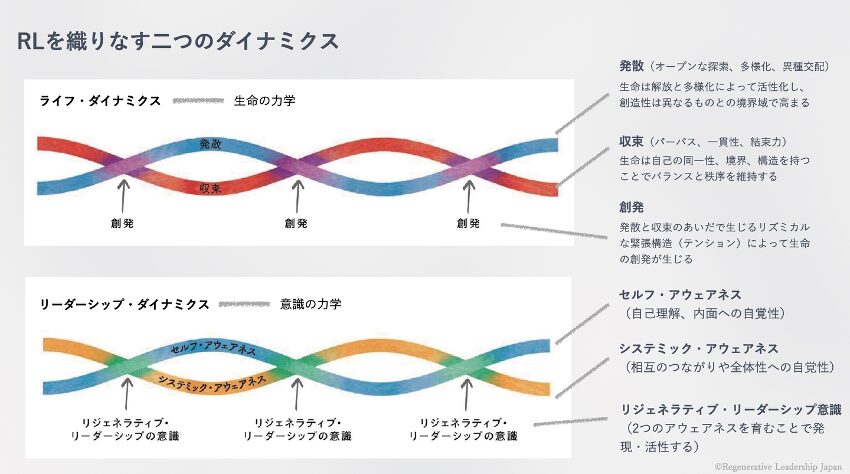
One is the “Dynamics of Life,” the fundamental forces of living systems. It refers to the continual cycles of expansion and concentration—creation and dissolution—that occur throughout the natural world, forming the larger flow of life energy that continually generates the new.
The other is the “Dynamics of Leadership,” the dynamics of consciousness. This refers to the movement of our own inner awareness: noticing what is happening within ourselves (self-awareness) and noticing what is happening in the external world around us—our teams, society, and the natural environment (systemic awareness).
Within these two overarching dynamics, three domains of practice naturally emerge.
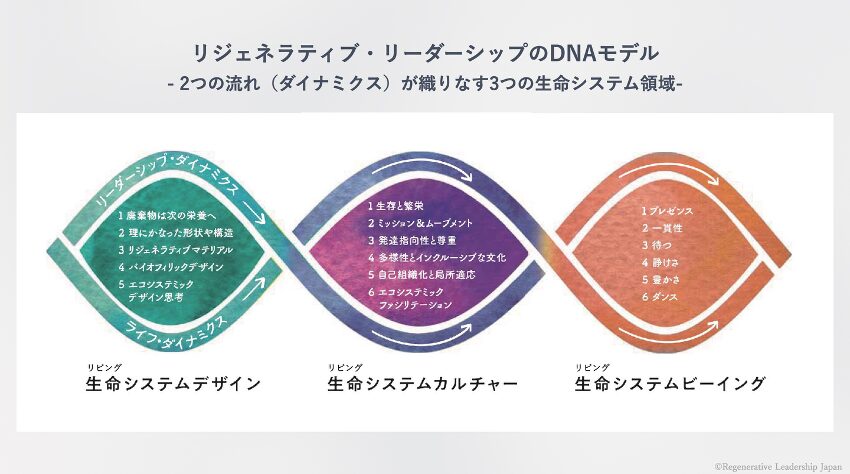
This domain deals with business and socio-economic systems, focusing on how products, services, and business processes can be designed by drawing upon the wisdom of the natural world. It aims to create businesses that contribute to broader ecological relationships—relationships that have often been overlooked within traditional human-centered paradigms. This domain also connects closely with ecosystem design in urban environments.
This domain focuses on the inner dynamics of organizations, applying the principles of living systems to organizational and community contexts. It offers the essential foundations for building organizations full of vitality—ones that move beyond the old mechanistic paradigm and can adapt swiftly to rapidly changing environments.
Regenerative leaders view organizations as living systems and continuously attune them to the flows and wholeness of the surrounding ecosystem, cultivating the right conditions for the organization to thrive.
This role, often referred to as an ecosystemic facilitator, is defined as a key leadership capability for the era ahead.
This domain concerns the way each individual shows up in the world. The very fact that “being” is included in the DNA model carries an important message: in the age of regeneration, how each person relates to and participates in the world deeply matters.
We are being called to embody ways of being that harmonize with the rhythms of life—not ways that amplify division, conflict, or structural inequality, but ways rooted in our inner truth and integrity.
Kobayashi notes that “in companies truly practicing regenerative leadership, the regeneration of business (design) and the regeneration of the organization (culture) and the individual (being) always move in tandem, like two wheels working together.”
(Text: Michi Sugahara / Photos: Shuji Goto)
In the second half of this article, we will introduce key insights for envisioning and practicing a regenerative future for cities.
▼Book Introduction
Regenerative Leadership: The DNA of Life-Affirming People and Organizations — Cultivating Renewal and Emergence
Authors: Laura Storm, Giles Hutchins / Translator: Yasuhiro Kobayashi
Publisher: Eiji Press
Leaders embracing a new paradigm—one that shifts from “machines” to “living systems” and seeks the flourishing of entire ecosystems—are emerging around the world. Integrating a wide range of case studies and academic insights, this is one of the most influential practical guides to regeneration today.
It offers a framework for reconnecting the divides between “people and nature,” “inner and outer,” and “masculine and feminine,” while guiding readers through the DNA model of regenerative leadership (Design × Culture × Being).

Representative Director / Founder, Ecological Memes
Ecosystemic Catalyst / Regenerative Facilitator
Owner, Kasukabe Farm (Regenerative Community Farm)
Kobayashi is the founder and representative of Ecological Memes, a collective exploring and practicing regeneration—reimagining the relationship between humans and nature and pursuing a future where people can thrive together with other forms of life and the Earth.
After traveling through 28 countries including India and Kenya, he worked in entrepreneurial support for social ventures. He later supported business creation and organizational transformation grounded in individual purpose across a wide range of industries before becoming independent.
He now works as a freelance catalyst and co-creation facilitator, supporting regenerative business development, organizational transformation, and leadership cultivation for a circular, regenerative society.
His motto is “go with the flow.” He is a father of one, and his personal interests have led him to become a licensed tour guide and obtain qualifications in traditional Chinese medicine and medicinal cuisine.
He also runs Kasukabe Farm, a regenerative community farm. In December 2024, he established Regenerative Leadership Japan to introduce, deepen, and advance the practice of regenerative leadership in Japan through lectures, advisory work, executive support, and leadership programs.
Instagram: @yasu_em
X (formerly Twitter): @yasu_cs
https://lit.link/yasuhirokobayashi