From Sustainability to Regeneration
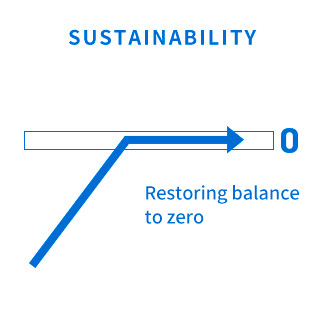
However, the effects of climate change are already evident, and it’s becoming clear that “maintaining” is no longer enough. The pandemic also reminded us that GDP growth alone does not necessarily lead to human happiness.
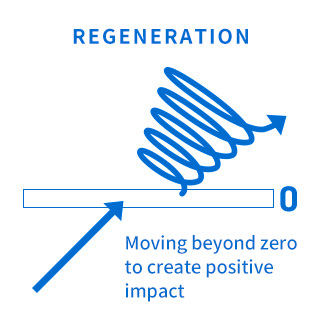
Regeneration, building upon the foundation of sustainability, shifts the goal from zero to positive—actively restoring the environment while generating new value for the economy, society, culture, and collective well-being.
Emerging Approach
Traditional Approach
Why Transformation Is Needed
Climate change is no longer just an environmental issue—it is reshaping business models, supply chains, and even the norms of our daily lives.Raw material sourcing is becoming unstable, and traditional distribution systems are struggling to function. These shifts have already become a reality across many industries.
At the same time, the pandemic profoundly altered our sense of value. Beyond economic growth, people now seek health, connection, emotional richness, and a sense of belonging to their communities. How can we realize such diverse forms of well-being that cannot be measured by economic indicators alone? Existing systems are no longer capable of meeting these pluralistic needs simultaneously.
That is why we must move beyond partial solutions and re-imagine entire systems—creating new frameworks and rules for a better future.This is not only a challenge but also a remarkable opportunity: to realize improvement across every domain—environmental, economic, social, cultural, and personal.
To see change not as a risk but as a chance to generate new value—that is the essence of the regenerative approach.
The Essence of the
Regenerative ApproachFive Core Principles

Beyond zero—toward positive impact
Regeneration goes beyond simply minimizing consumption or avoiding harm—it works to strengthen ecosystems and biodiversity Improving the environment can simultaneously create new business opportunities and revitalize communities—pursuing value creation that is greater than the sum of its parts.

Dynamic Evolution Over Static Maintenance
Instead of returning to the past or maintaining the status quo, regeneration embraces continuous evolution, where both the environment and human society progress toward better states.Cities are seen as living systems—learning, adapting, and improving through dynamic change.

A future where diversity is honored and prosperity is shared
Economy, culture, society, environment—each stakeholder values something different.
Rather than trade-offs, regeneration envisions a world where all can flourish together: not “environment or economy,” but “environment and economy and society and culture.”
By weaving together diverse perspectives, we can co-create a future everyone can believe in.

Nature as Collaborative Partner
Nature is not merely a resource to be used—it is a partner to learn from.
By drawing on ecosystems’ inherent regenerative power and circularity, we can integrate nature’s wisdom into urban systems.
Through this collaboration, we restore nature within cities and design spaces that thrive in harmony with it.

System Change for the Creation Multi-Dimensional Value
By reexamining entire value chains through cross-sector collaboration, a single initiative can create impact across economy, environment, society, and culture.
Regeneration emphasizes value creation for multiple stakeholders—humans, nature, and future generations alike.
The Future We Createfrom Regenerative City Tokyo
Driving systemic change together to realize environmental, economic, social, and cultural value—and collective well-being.